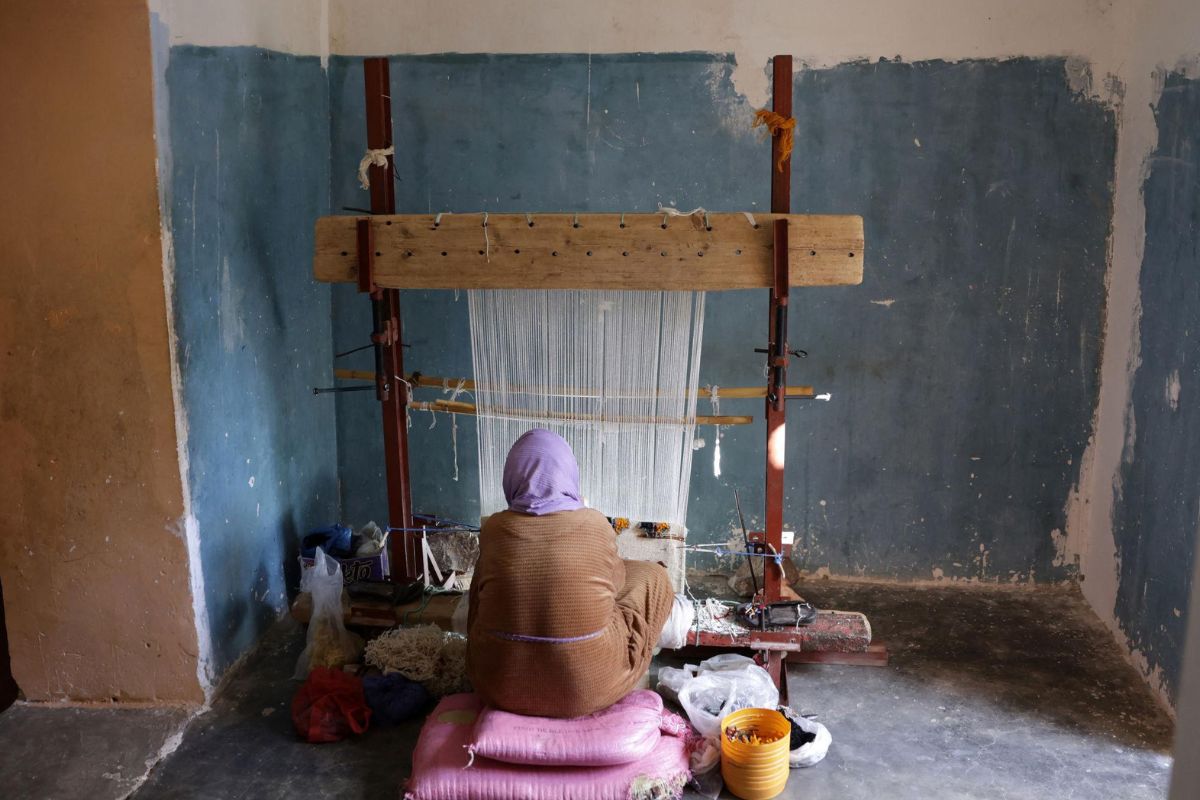
The machine, if you want to call it that, is a vertical wooden loom: two horizontal beams held apart in an upright frame, with the warp threads wound between them under tension, worked from the bottom upward. There is no motor, no shuttle mechanism and no punch card. Africanews, reporting from Taznakht in July 2025, described the weavers there working on traditional wooden looms of exactly this kind, and AFP photographed a weaver in the same town at a wooden loom set up outside her house. The loom is simple enough to be built, dismantled and moved, and that simplicity decides more about the finished rug than most buyers realize.
The parts, and what each one does
- The frame and the two beams. The upper and lower beams carry the warp. As weaving progresses, finished work can be wound down and fresh warp brought up, so the rug can be longer than the loom is tall.
- The warp. The vertical threads, tensioned between the beams. They are the skeleton of the rug and the thing every knot is tied onto.
- The weft. The horizontal threads passed through the warp. In a flatweave the weft is the whole design. In a pile rug it locks the knot rows in place.
- A heddle rod and shed stick. Simple devices that lift alternate warp threads so the weft can pass through in one movement instead of being threaded over and under by hand.
- The comb, or beater. A heavy toothed tool used to drive each new row down hard against the last. How firmly this is done sets how dense and how stiff the finished rug is.
- A knife or shears. For cutting pile knots to length and, at the end, cutting the rug free.
None of this is exotic and none of it is recent. It is a frame, string under tension, and a person.
Why a loom that can be dismantled matters
A vertical loom of this construction comes apart into poles and beams that can be carried. In a pastoral and semi-nomadic setting, that is not a design detail, it is the whole reason the object works: the loom goes where the household goes, and it is put up again inside or beside the home rather than in a workshop built for it.
That portability also explains something about the geography of the craft. Related loom types and related patterns run across North Africa rather than stopping at a regional boundary, which is one reason attributing a rug to one named group by pattern alone is unsafe, and why the term "Berber rug" covers so much ground so loosely. Where the loom lives has been changing, though. Africanews describes weaving in Taznakht moving from homes into cooperative workshops, which is a real shift in working conditions and in who is present while a rug is made.
What the loom decides about the finished rug
This is the part worth carrying into a listing.
Width. The warp can only be as wide as the loom, so the loom sets the maximum width of the rug. Length is much less constrained, because finished work can be wound on. That asymmetry is one straightforward reason long narrow pieces are so common in Moroccan weaving, a point that sits behind the Moroccan runner as a format rather than a fashion.
Dimensions that are not quite true. Warp tension is set by hand and varies across the width. Beating the weft down is done by arm. A handwoven rug therefore tends to come off the loom slightly irregular, a few centimetres wider at one end, edges not perfectly parallel, corners not exactly square. That is normal and is not a defect, and it is why hand-knotted pieces are so often listed at odd measurements rather than at standard retail sizes.
Density and stiffness. How hard each row is beaten down changes how tightly packed the finished weave is. Two rugs with the same knot structure can feel very different underfoot because of it.
Pile and flatweave on the same loom
The loom does not distinguish between the two main construction families. The same vertical frame produces both.
For a flatweave there are no knots: the pattern is built entirely from weft passing through warp, which is how Moroccan kilim and hanbel weaving is made. For a pile rug, rows of knots are tied onto the warp and beaten down, with plain weft passes between them holding everything together. Some traditions combine the two within one piece, which is what makes Glaoui weaving behave differently in different sections of the same object. If you are choosing between the two families on practical grounds, flatweave versus pile is the comparison, and the loom is the reason a single weaver can produce either.
Reading the loom from the finished rug
You cannot see a loom in a listing photograph, but you can see what it left behind. The direction of the warp tells you the direction the rug was woven. The selvedges, the finished side edges, are formed as the weaving proceeds and are a different structure from the ends, where the warp is cut and secured. Slight waviness along an edge, a small difference between the two ends, gentle banding across the field where a new batch of handspun yarn came in: all of these are the traces of a hand-tensioned warp and a human arm on the beater.
Machine production leaves the opposite signature, because it is built to eliminate exactly this variation. That contrast is the most reliable check available from photographs, and it is set out in full in handmade versus machine-made.
An honest note on the sources for this page
The loom is the least well documented part of this subject in English, which is worth saying out loud. Museums exhibit Moroccan looms as objects, including the loom installed in the gallery for The Fabric of Moroccan Life at the Indianapolis Museum of Art in 2002 and at the Smithsonian's National Museum of African Art in 2003, and news reporting describes them in passing as traditional wooden looms. What is thin online is a technical account of the Moroccan loom written by anyone other than a rug seller.
The descriptions above are therefore the uncontested structural basics of a two-beam vertical loom, supported by what the reporting from Taznakht actually says, and this guide has not filled the remaining gaps. In Amazigh usage the loom and the act of weaving are commonly given the same word, usually written azetta, a term that appears in Amazigh studies scholarship; the underlying academic work was not accessible to this guide, so the term is flagged as one you will meet rather than translated with confidence here. Where you see a page giving elaborate ritual specifics about how a loom is raised, ask where that came from, because the sourced English-language record is much smaller than the confident material suggests.
FAQ
What kind of loom is used for Moroccan rugs?
A vertical wooden loom: two horizontal beams in an upright frame with the warp tensioned between them. Reporting from Taznakht in 2024 and 2025 describes traditional wooden looms of this type in home and cooperative settings.
Is a Moroccan rug loom powered?
No. It is a hand loom. The weaver passes the weft, ties any knots, and beats each row down with a hand comb. There is no motor and no mechanized shuttle.
Why are handwoven Moroccan rugs not perfectly rectangular?
Because warp tension is set by hand and beating is done by arm. Small variations across the width produce edges that are not exactly parallel and corners that are not exactly square. It is a normal outcome of loom weaving, not a fault.
Does the loom limit how big a rug can be?
It limits the width, since the warp cannot be wider than the loom. Length is far less limited, because finished weaving can be wound onto the lower beam as work continues.
Can the same loom make both flatweave and pile rugs?
Yes. The difference is technique, not equipment. A flatweave uses weft alone for the pattern; a pile rug adds rows of knots tied to the warp, beaten down between weft passes.
Leave a Reply