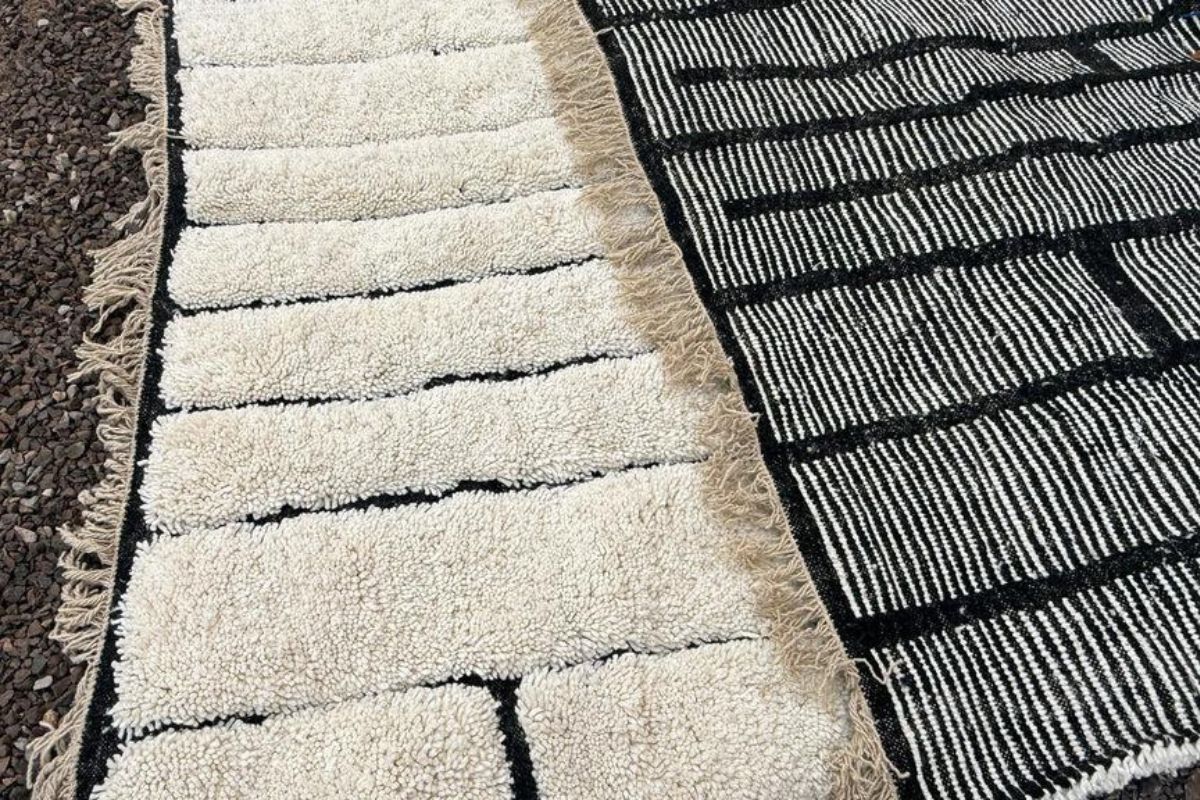
If you're choosing between a plush style like Beni Ourain and a flat one like Zanafi or a Moroccan kilim, the underlying question is construction, not just look. Flatweave rugs are thin, firm, and low-shedding, which suits high-traffic areas, hallways, dining rooms, and anywhere furniture needs to move freely or a door needs clearance. Pile rugs are thicker and softer, with vertical yarn that adds cushioning and sound absorption, which suits living rooms, bedrooms, and spaces where comfort underfoot matters more than low-profile practicality. Moroccan weaving produces genuine, distinct styles in both categories. This isn't a compromise choice.
Quick comparison
| Flatweave | Pile | |
|---|---|---|
| Thickness | Thin, flat | Thick, raised surface |
| Feel underfoot | Firm | Soft, cushioned |
| Shedding | Minimal | Noticeable, especially when new |
| Best rooms | Hallways, kitchens, dining rooms, stairs | Living rooms, bedrooms |
| Example Moroccan styles | Zanafi, Moroccan kilim/hanbel, Boucherouite | Beni Ourain, Beni Mrirt, Beni Mguild, Azilal, Boujad |
| Reads on both sides? | Often, yes | No, pile faces one direction |
What "pile" actually means, and which Moroccan styles are pile
A pile rug is built with vertical yarn, the pile, standing up from a woven backing, either left as loops or cut, giving the surface height, softness, and texture you can run a hand through. That construction is what makes a pile rug feel warm and cushioned underfoot, but it also means more surface area to trap dust and shed loose fiber, especially when new.
On this site, the pile family includes the Middle Atlas styles built around plush wool: Beni Ourain, Beni Mrirt, and Beni Mguild, along with the denser, more colorful pile traditions like Azilal and Boujad. These are the rugs people picture when they imagine a thick, soft Moroccan rug underfoot in a photo, the ones that read as substantial the moment you step on them.
What "flatweave" actually means, and which Moroccan styles are flatweave
A flatweave rug has no raised pile at all. The warp and weft yarns are woven tightly together into a flat, thin surface, with the pattern visible on both the front and often the back of the piece. That construction produces a thinner, firmer, more durable-underfoot rug that lies flatter, wears differently than a pile rug, and generally sheds far less because there's no loose vertical fiber to begin with.
Zanafi rugs, reversible flatweaves with a finished look on both sides, sit squarely in this category, as does the broader Moroccan kilim and hanbel family. Boucherouite rugs, the rag-weave style made from recycled textile scraps, are also generally flatwoven, which is part of why they can incorporate such varied, reused materials in the first place. A knotted pile construction would demand a much more uniform yarn supply than a rag weave does.
Room-by-room fit
Hallways, entryways, and stairs. A flatweave's low profile and durability make it the more practical choice anywhere a rug needs to withstand frequent foot traffic without bunching under a door or catching a shoe. A thick pile rug in a narrow, high-traffic hallway will show wear faster and can become a trip hazard if it isn't properly secured.
Kitchens and dining rooms. Flatweave again, for the same reasons: easier to keep clean underfoot, and chair legs move across a flat surface more easily than across a deep pile, which matters directly under a dining table.
Living rooms and bedrooms. This is where pile earns its keep: the comfort, warmth, and sound-dampening qualities of a plush Middle Atlas style are exactly what these rooms are for. A living room built around lounging on or near the floor, or a bedroom where bare feet hit the rug first thing in the morning, is the natural home for a Beni Ourain or Beni Mguild.
Home offices and casual spaces. Either can work, depending on whether a rolling chair is involved. A flatweave handles a desk chair's wheels far better than a deep pile does; a low-pile option is a reasonable middle ground if comfort matters more than chair mobility.
The middle ground: mixed-technique weaves
Not every Moroccan weaving fits neatly into one category. Glaoui rugs combine flat, pile, and fringe techniques within a single piece, which is worth knowing if you've found one and are trying to judge how it will behave underfoot: parts of it will perform more like a flatweave, and parts more like a pile rug, within the same physical object. That's a genuinely different profile from either pure category, and one more reason "flatweave or pile" is a useful starting question rather than a rigid binary once you're looking at a specific named tradition.
Spotting the difference in a photo
Even without touching the rug, construction is often visible in a decent listing photo. A pile rug shows visible height and shadow along the surface, with individual tufts or a clearly textured field; a flatweave reads as flat and graphic in a photo, with the pattern rendered in solid blocks of color rather than a soft, textured surface. If a listing shows the back of the rug, that's an even stronger tell: a flatweave's pattern is usually visible, mirrored or near-identical, on the reverse side, while a pile rug's back shows the knot structure rather than the front-facing pattern itself. This is one of the more reliable checks available from a photo alone, compared to some of the harder authenticity questions covered in how to identify a Moroccan rug from a photo.
What this doesn't determine
Construction type says nothing about a rug's age, origin, or authenticity: those are separate questions covered on the individual style pages. A flatweave isn't automatically older or newer, more or less authentic, than a pile rug; it's a different, equally legitimate construction technique with its own named traditions behind it. Nor does construction type tell you whether a specific piece is hand-knotted or hand-woven at all. A machine-made reproduction can imitate the look of either category, which is a separate check covered elsewhere on this site.
FAQ
Is a flatweave rug lower quality than a pile rug?
No. They're different constructions with different strengths, not a quality hierarchy. A well-made flatweave and a well-made pile rug are both genuine, skilled hand-weaving, suited to different practical uses.
Which is better for a room with pets or kids?
Flatweave generally holds up better to heavy, frequent use and sheds less, which matters in high-activity rooms. Pile rugs can still work in these spaces; they just need more maintenance and are more forgiving in lower-traffic rooms.
Do flatweave Moroccan rugs shed less than pile ones?
Generally yes, because there's no loose vertical pile fiber to shed in the first place. New pile rugs in particular can shed noticeably at first.
Can a Moroccan rug be both pile and flatweave?
Yes, Glaoui rugs are a documented mixed-technique tradition combining flat, pile, and fringe sections within one piece.
Does construction type tell me anything about a rug's age or authenticity?
No. Pile and flatweave are both long-standing, legitimate construction techniques across Moroccan weaving traditions. Neither one is inherently older, newer, more, or less authentic than the other.
Leave a Reply