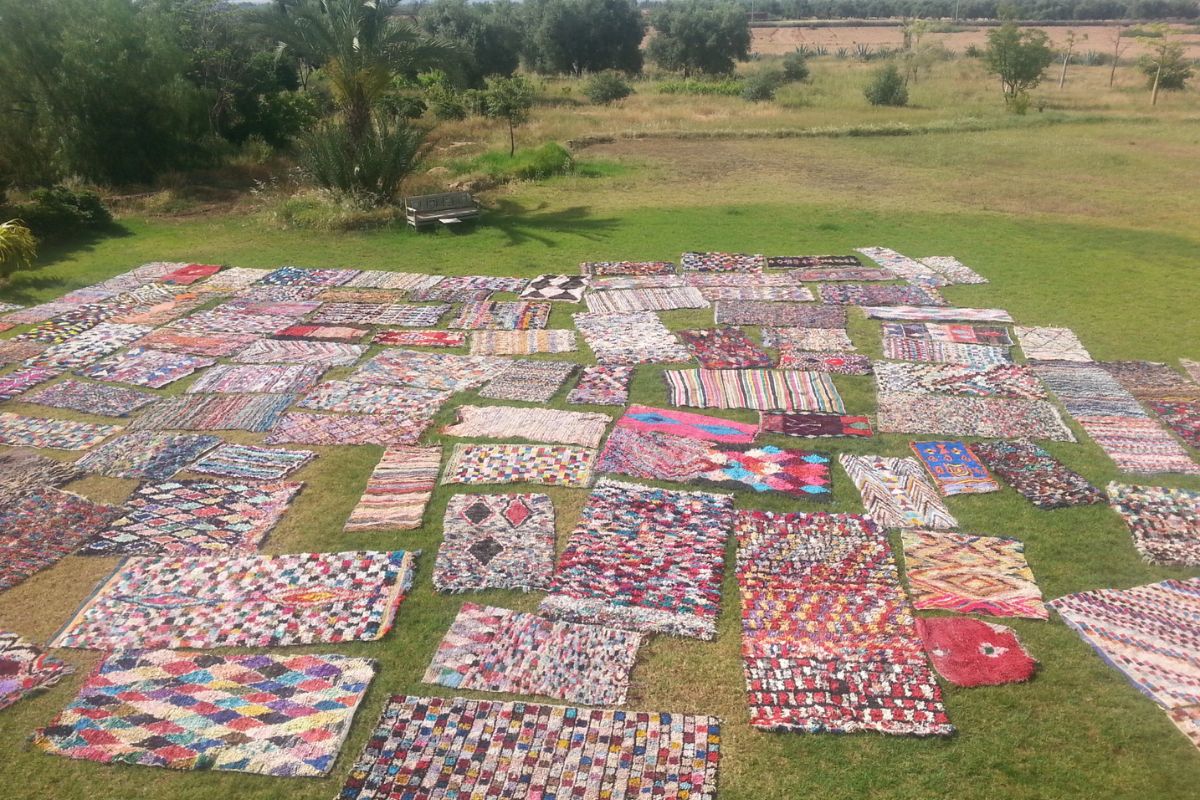
Genuine hand-knotted and handwoven Moroccan rugs do exist as runners (long, narrow pieces suited to hallways and stairs), particularly among flatweave traditions. Rounds are a different matter: they're mostly a modern reproduction-rug format rather than a traditional Moroccan output. And whatever shape you're after, a genuinely hand-knotted piece won't come in a fixed factory size the way a mass-produced rug does; it comes in whatever size the loom and the weaver actually produced.
Two very different markets are hiding behind the same search term
Search "Moroccan runner rug" or "Moroccan round rug" and most of what comes back is machine-made reproduction product from mainstream rug retailers (Amazon, big-box rug sites, and decor-focused online stores), sold in standard factory sizes: runners commonly listed from around 2×3 feet up through 8×10, 9×12, and larger, rounds commonly listed in fixed diameters like a 5-foot round. That's a real, legitimate product category, and there's nothing wrong with buying one if a consistent factory size and a lower price point matter more to you than a hand-knotted piece. But it's a different product from what the rest of this site covers, and conflating the two leads to mismatched expectations: someone expecting to shop a genuine hand-knotted runner the way they'd shop a standard-size reproduction rug is going to be looking for something that, by its nature, mostly doesn't exist that way.
Runners: where they show up in genuine Moroccan weaving
Long, narrow formats are a real, traditional output in some Moroccan weaving, particularly among flatweave traditions like Zanafi and the broader Moroccan kilim and hanbel family, where the flat construction lends itself naturally to a longer, narrower piece without the bulk a pile weave would add over the same length. A genuine hand-knotted pile runner also exists, but tends to be less common than a flatwoven one, since building a long, narrow, plush pile piece is a more demanding, time-intensive undertaking on the loom than a flatweave of the same dimensions.
Whatever the construction, a genuine runner's exact length and width are a function of that specific loom and that specific piece, not a menu of standard options. If you need a very specific length, filling an exact hallway measurement, for instance, expect that to be the harder ask, not the easier one, when shopping genuine hand-knotted pieces rather than mass-produced reproductions.
Rounds and other shapes: mostly a modern reproduction-rug format
Round rugs are heavily marketed in the general decor-retail space, but this guide did not find evidence that round is a traditional Moroccan hand-weaving output the way rectangular and runner formats are. Most round "Moroccan-style" rugs on the market are machine-made reproductions manufactured specifically in that shape for the modern decor market, not a hand-knotted piece originally woven round. That doesn't make a round reproduction rug a bad purchase on its own terms. It's simply a different category from the hand-knotted traditions this site covers, and calling it "Moroccan" describes its design influence, not necessarily its origin or construction.
Other irregular shapes (oval, hexagonal, custom-cut pieces) fall into the same bucket: they exist in the market, but predominantly as manufactured decor product cut or woven specifically to that shape for a modern retail audience, not as a traditional Moroccan weaving format this guide can document.
Machine-made reproduction rugs vs. genuine hand-knotted pieces: why the size charts differ
A machine-made rug is produced on equipment that can output a consistent size on demand: that's precisely the appeal of a standard size chart, and why reproduction retailers can confidently list 2×3, 5×8, 9×12, and every size in between. A genuinely hand-knotted or handwoven rug is produced by one person (or a small group) on a specific loom, over weeks or months, and its finished dimensions are the result of that particular weaving process, not a target size dialed in beforehand the way a factory setting is. That's precisely why hand-woven Moroccan rugs are widely described in the trade as irregular in size: a piece sold as "roughly 6×9" may run somewhat larger or smaller than that in either dimension, because it was never built to a fixed spec in the first place.
This matters directly for anyone shopping by exact room measurements. See the complete guide to Moroccan rug styles for the wider identification context, but the size question specifically is worth internalizing on its own: a hand-knotted piece's dimensions are a description of what exists, not an order specification for what will be produced.
What to expect if you want a specific size or shape in a genuine piece
- Expect "roughly," not "exactly." A listed dimension on a genuine hand-woven piece is a description, with normal handmade variation built in, not a guaranteed precise measurement.
- A specific exact length is a harder ask than a general size range. If a hallway genuinely needs an exact 27-inch width, that's a much narrower search than "a runner, roughly 2 to 3 feet wide."
- Rounds and unusual shapes in genuine hand-knotted construction are rare enough that "Moroccan-style round rug" almost always means reproduction, not traditional weaving, worth knowing going in, rather than assuming a round piece is automatically a hand-knotted antique.
- If exact dimensions matter more than authenticity, a reproduction rug is a legitimate, honest option. This guide isn't arguing everyone should only buy hand-knotted pieces, only that the two categories shouldn't be confused with each other while shopping.
Measuring your space against an irregular piece
Because a genuine hand-woven piece's dimensions are fixed by what was actually made rather than a size you select, the practical approach is to measure your space first and then shop within a range, rather than deciding on an exact number and searching for that precise figure. For a hallway runner, that usually means noting the minimum and maximum width the space can accommodate, and treating anything within that range as a candidate, rather than ruling out a piece that's an inch or two off a single target number. For a room where you're considering an unusual shape, the more useful question is often whether a standard rectangular piece (this site covers many genuine, well-documented styles) would actually serve the space just as well as the odd shape you originally had in mind.
FAQ
Do genuine Moroccan runner rugs exist?
Yes, particularly among flatweave traditions like Zanafi and Moroccan kilim/hanbel, where the construction naturally suits a longer, narrower format.
Are round Moroccan rugs traditional?
This guide did not find evidence that round is a traditional hand-woven Moroccan output. Most round "Moroccan-style" rugs on the market are modern reproductions manufactured specifically in that shape.
Why don't hand-knotted Moroccan rugs come in standard sizes like 5×8 or 9×12?
Because they're produced by a person on a specific loom over an extended period, not manufactured to a fixed factory spec. Dimensions reflect what was actually woven, with normal handmade variation.
Can I order a genuine Moroccan rug in an exact custom size?
This is a much narrower, harder request than shopping standard reproduction sizes, since it depends on finding or commissioning a specific piece rather than selecting from a size chart. This guide cannot promise availability for any specific custom size.
Is a machine-made reproduction "Moroccan-style" rug a bad choice?
Not inherently. It's a legitimate, different product category with its own honest use case, particularly where an exact size, shape, or lower price point matters more than hand-knotted construction. The problem is only in confusing the two categories while shopping.
Leave a Reply