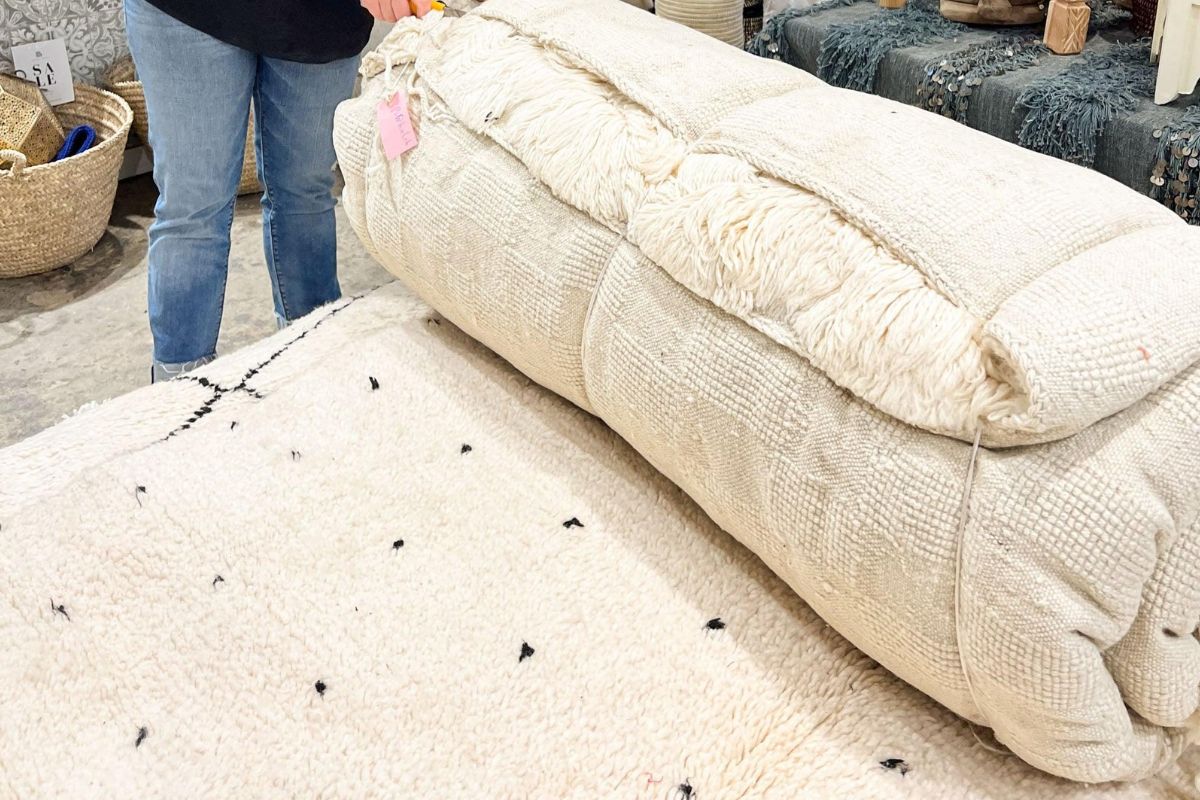
There are three ways to get a rug home: carry it yourself, let the seller arrange shipping, or hire your own courier or freight forwarder. They differ less in price than in who holds the risk if something goes wrong. Carrying it yourself is the only route where the rug never leaves your possession, and it is the option most buyers dismiss too quickly. Whichever you choose, the routine that protects you is the same: photograph the exact piece, get its measured dimensions in writing, and know who is actually carrying it.
Route one: carrying it yourself
Most buyers assume a rug is too big for luggage. Many are not. Wool folds and compresses considerably more than people expect, and a rug that looks impossible spread across a shop floor often flattens into a manageable bundle.
The advantages are decisive when it works. The rug never leaves your hands, so substitution is impossible, non-delivery is impossible, and there is no customs paperwork happening without you. You also skip the entire question of who insured what.
The limits are real too. Airline baggage allowances, oversize rules and excess fees vary by carrier, route and ticket class, and this guide will not quote any of them because they change and they differ for every reader. Check your own airline's published allowance before you buy, not after. A large, dense pile rug can be genuinely heavy, and weight is usually the binding constraint rather than size.
If you are travelling on to other stops, factor in carrying it for the rest of the trip.
Route two: seller-arranged shipping
This is what most shops offer, often before you have finished deciding, and for a lot of buyers it is the practical answer. Shops that ship regularly have a relationship with a carrier and it usually works.
The risk it introduces is substitution: the rug that arrives is not the rug you chose. This is not primarily a story about dishonesty. A shop with dozens of similar pieces, a rug rolled after you leave, and a week between purchase and dispatch creates room for an honest mix-up as well as a dishonest swap. Either way you are the one holding a rug you did not pick.
The second risk is that recourse is remote. If something is wrong, your counterparty is a shop in another country, and whatever protection you have comes from your payment method rather than from the transaction itself.
Ask three things before agreeing: who is the actual carrier, will you get a tracking number, and who bears the risk if the rug is lost or damaged in transit.
Route three: your own courier or freight forwarder
Arranging shipping yourself, through an international courier or a freight forwarder, puts a contracted third party between you and the shop.
The advantage is that the carrier is accountable to you rather than to the seller, you choose the insurance, and the handover is documented. For a genuinely expensive rug this is usually the most defensible option.
The costs are effort and money. You will be quoted on dimensional weight as well as actual weight, a rolled rug is an awkward shape, and someone has to get the rug from the shop to the depot. Some forwarders will collect. Ask before you assume.
This is also the route where customs paperwork is most likely to be handled properly, which matters more than it sounds. Customs, duty and declared value on an imported rug covers what arrives with the rug.
The evidence routine that protects you on any route
Do this in the shop, before the rug is rolled. It takes four minutes and it is the difference between a dispute you can win and one you cannot.
- Photograph the exact rug, front and back, whole and in close-up, with something in frame for scale. The back matters most, because it is effectively a fingerprint: no two hand-knotted rugs have the same irregularities. What the back of the rug shows explains what you are looking at.
- Photograph any damage, repair or unusual feature. These are identifying marks.
- Get measured dimensions on the receipt, taken at both ends and both sides, not a rounded description. Hand-woven rugs are rarely perfectly rectangular, and the exact numbers identify the piece.
- Have the receipt describe the rug, including construction and any claim the seller made about it.
- Photograph the rug being rolled, if you can do it without being strange about it.
- Get the carrier name and tracking, not a promise that it will be sent.
Insurance, damage and what to do on arrival
Insurance follows declared value, which is the quiet trap. If the value declared for customs is lower than what you paid, that lower figure is usually the ceiling on any claim. A seller offering to declare a low value is not doing you a favour, and rug scams and the "avoid customs" offer covers why.
Ask who insures the rug in transit and for how much. On seller-arranged shipping the honest answer is often nobody, and it is better to know that in the shop.
On arrival, before you sign for anything if the carrier allows it: check the packaging for damage and note it on the delivery paperwork. Then unroll the rug and compare it against your photographs, particularly the back. Do this the day it arrives, because claim windows are short and they are defined by your carrier and your payment provider, not by this page.
If the rug is wrong, returns and recourse covers the ladder in order. If you have not bought yet, buying a rug in the Marrakech souk covers the encounter itself, and how to buy a Moroccan rug without getting taken covers the whole set of risks. For unusually long or awkward pieces, Moroccan runners, rounds and odd shapes is worth reading before you commit to a size you then have to move.
FAQ
Can I take a Moroccan rug home in my luggage?
Often yes. Wool compresses more than buyers expect, and weight is usually the binding limit rather than size. Check your own airline's published baggage and oversize rules before buying, since they vary by carrier, route and ticket.
Is it safe to let the shop ship the rug for me?
It usually works, and it introduces substitution and remote-recourse risk. Get the carrier name, a tracking number, and a receipt describing that specific rug with measured dimensions, and photograph the piece front and back before it is rolled.
Who pays if the rug is damaged in transit?
It depends on the carrier's terms and what was insured, and often the answer is nobody. Ask explicitly who insures it and for how much before the rug leaves the shop.
Should I use a freight forwarder?
For an expensive rug it is usually the most defensible route, because the carrier is accountable to you and you choose the insurance. It costs more effort and you will be quoted on dimensional weight.
What is the single most useful thing to do before shipping?
Photograph the back of the rug. The irregularities are effectively a fingerprint, and it is the evidence that settles a substitution dispute.
Leave a Reply