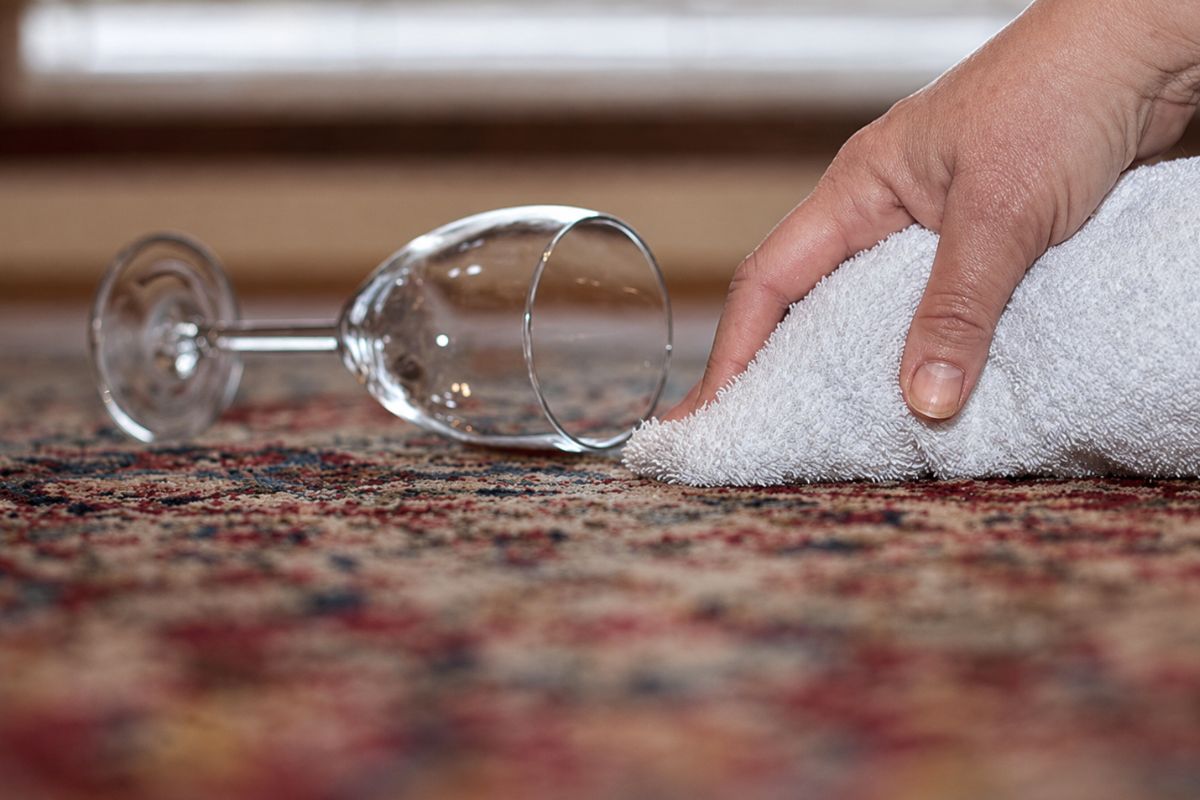
Do these five things now, in this order. One: lift or scoop away anything solid with a spoon or a blunt edge, do not press it in. Two: blot with a clean white cloth or plain kitchen paper, pressing straight down, working from the outside of the spill inward. Three: keep swapping to a dry part of the cloth until it stops lifting colour. Four: if you use liquid at all, use a very little plain cool water and blot again, never soak. Five: press dry, weight it with a dry towel, and let air get to it. Do not rub, do not use heat, and do not reach for a spot cleaner.
Why blotting and not rubbing, on wool specifically
Rubbing does two things to a hand-knotted wool pile, both bad. It pushes the spill down through the pile toward the foundation, where it is far harder to remove and where it can wick back up as the rug dries. And it abrades the fibre surface, leaving a fuzzed patch that stays visible after the stain itself has gone.
Blotting works because of lanolin. The natural grease in good wool repels liquid for a short window before absorption, which is why a wool rug survives spills that would ruin other fibres, and why speed matters more than technique. You are racing that window, not scrubbing a surface.
Work from the outside in for the same reason you would with any textile: pressing at the centre of a spill spreads it outward into clean pile and makes the mark larger than it needed to be.
What to use, and what must never touch it
Safe: a clean white absorbent cloth or plain white kitchen paper, and a small amount of plain cool water. White matters, because a coloured cloth can transfer its own dye into damp wool.
Only with care: a product that explicitly states it is safe for wool, used exactly as its own manufacturer directs, and tested first on a hidden corner or the rug's underside. Apply it to the cloth rather than pouring it onto the rug.
Never, and each of these is permanent:
- Oxygen bleach, the active ingredient in most "oxy" spot cleaners. It bleaches wool, and the pale patch does not come back.
- Chlorine bleach.
- Enzyme cleaners. They are formulated to break down protein and wool is protein.
- High-alkaline all-purpose household cleaners. Alkalinity felts the fibre, strips lanolin and destabilises dyes.
- Hot water, steam or a hairdryer on a hot setting. Heat sets many stains and accelerates every kind of wool damage.
Never combine products. Professional rug cleaning sources describe wool as wanting pH-neutral treatment, with professional formulations in the range of roughly 5.5 to 8.0, and that is the whole reason the list above exists. Cleaning products that quietly destroy wool goes through the cupboard properly.
Common spills and where each one differs
Water, tea or coffee without milk. Blot hard and fast. Most of it lifts if you get there quickly.
Red wine, juice and anything strongly coloured. Blot immediately and keep swapping cloth. Do not reach for the internet's favourite remedies here, because the strongly coloured spills are exactly the ones people try to bleach out, and bleaching wool is irreversible.
Milk, cream and anything with protein or fat. Lift the solids, blot, then be patient. These are the ones that develop an odour if any residue is left in the pile, and they are a good candidate for professional help rather than escalating at home.
Pet accidents. Blot what you can and treat this as a different problem. Urine that has reached the foundation is not a surface stain, it is a contamination and odour issue, and it commonly needs a professional. Do not use an enzyme cleaner on wool, despite it being the standard recommendation for pet accidents on synthetic carpet.
Mud and solids. Counter-intuitively, let it dry completely, then vacuum it up with a plain suction head. Attacking wet mud pushes it in. Vacuuming a wool pile rug covers doing that safely.
Wax and chewing gum. Do not apply heat. This is a job for someone who does it professionally.
The stop rule: when to leave it and call someone
Nearly every other page on this topic escalates you through progressively stronger interventions. This one tells you where to stop, because the second and third attempts are what turn a mark into permanent damage.
Stop now, and get a rug cleaning specialist, if:
- The rug is old, valuable, or you believe it carries natural dyes. These pieces are irreplaceable and this site's own position is that they are not DIY. Natural dyes also become less stable with age, so water can move colour in ways nothing will reverse.
- Colour is lifting into your cloth from the rug itself, rather than from the spill. Stop immediately. Continuing spreads a dye run across clean pile. Natural or synthetic dye explains why this happens and why it is not evidence your rug is fake.
- The spill has soaked through to the foundation.
- It is a pet accident, oil, wax, or anything you have already tried something on.
- You cannot get the area properly dry within a few hours.
Stopping is not giving up. A professional can almost always work with a damp spot handled sensibly. Far fewer can undo a bleached patch or a set dye run.
What to do about the mark that is still there tomorrow
Once the area is dry, look again in daylight. A faint shadow often turns out to be flattened pile rather than a stain, and gently working it with your fingers or a soft brush, with the pile direction, lifts it.
If there is still a real mark, resist the second round. This is the moment people cause the damage: the spill is no longer urgent, and the temptation is to try something stronger on a stain that is now set. Call a rug cleaning specialist rather than a general carpet cleaning service, and tell them what the spill was, what you have already used on it, and whether any colour lifted.
For the whole routine see how to care for a Moroccan wool rug, and if you are weighing a full clean, washing a wool rug at home, or not is built around the question that actually decides it.
FAQ
What should I do first when something spills on a wool rug?
Lift solids away, then blot straight down with a clean white cloth from the outside of the spill inward, swapping to dry cloth as it lifts. Do not rub and do not soak.
Can I use vinegar or baking soda on a wool rug?
This guide does not publish home remedies for wool. Use plain cool water sparingly, or a product that states it is safe for wool used exactly as its manufacturer directs and tested on a hidden area first.
Why can't I use an oxy spot cleaner?
Oxygen bleach lightens wool permanently. The pale patch it leaves cannot be reversed, and it is one of the most common causes of irreversible home damage to wool rugs.
Colour came off on my cloth. Is my rug fake?
No, and stop cleaning immediately. Bleeding means the dye was not fully fixed, which happens with natural and synthetic dyes alike, and continuing will spread it into clean pile.
Is a pet accident different from an ordinary spill?
Yes. Urine that reaches the foundation is a contamination and odour problem rather than a surface stain, and it usually needs a professional. Do not use enzyme cleaners on wool, even though they are standard advice for synthetic carpet.
Leave a Reply