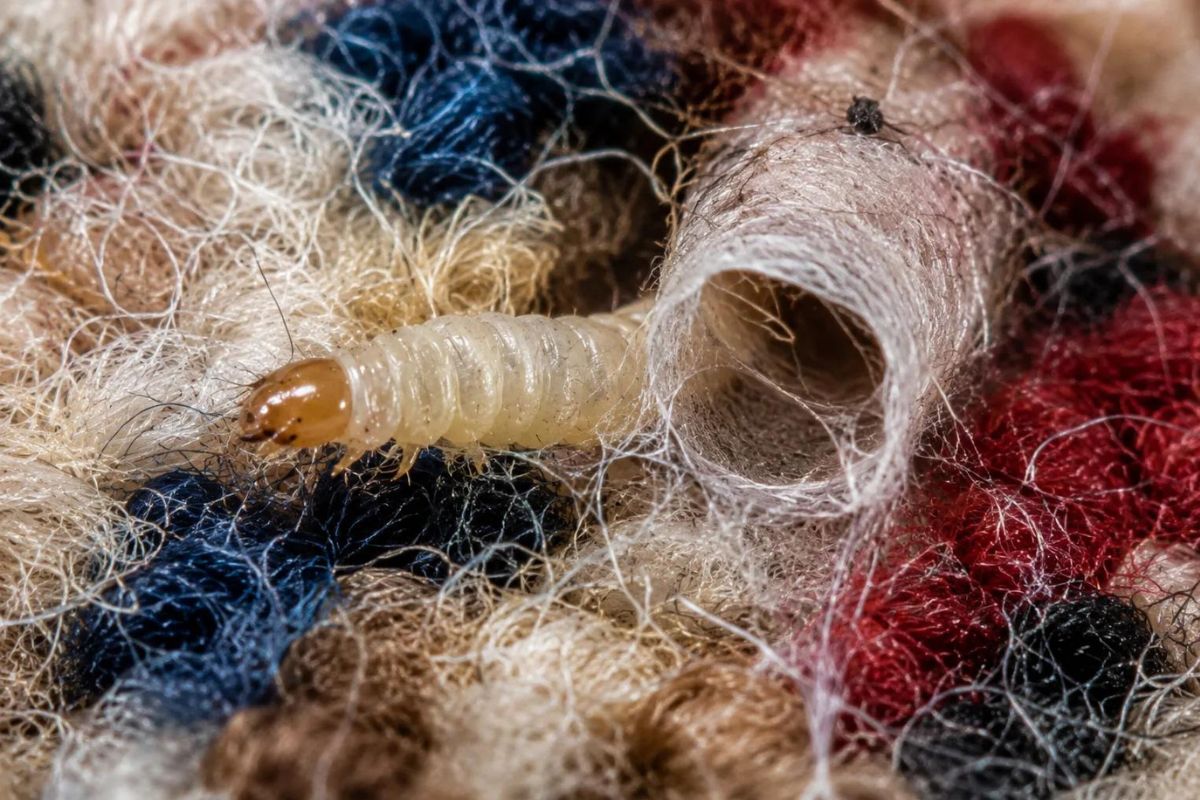
Something probably was living in it. The question that matters is whether it still is, and the signs that answer it are specific. Active looks like fine silk webbing across the pile, small pale tubular cases roughly 1 to 2 mm long tucked into the base, and sandy grit along the edges. Historic looks like clean-edged bare patches with none of that debris present. The damage is done by larvae, not by the adult moths you occasionally see, and they live where it is dark and undisturbed, so the middle of your floor tells you almost nothing.
Why wool, and why Moroccan rugs
Carpet moth larvae eat keratin, the protein in wool, hair and feathers. Synthetic carpet is not food. A hand-knotted wool rug is.
Two things make these rugs a common target. They are undyed or naturally dyed wool with lanolin still present, which is exactly what the larvae are looking for, and they are frequently placed where a rug sits for years without being moved, under a bed, beneath a heavy sofa, in a spare room. Larvae need darkness and stillness, and a rug that never moves supplies both.
None of this is a comment on the quality of the rug. Good wool is more attractive to them, not less.
Where to look, because the middle of the room tells you nothing
If you inspect the open floor and find nothing, you have learned nothing. Do this properly and it takes ten minutes.
- Lift the corners and the edges. Look at the base of the pile along the whole perimeter, and at the underside of the rug.
- Move the furniture. Under a sofa, under a bed, behind a chest of drawers. This is where infestations are found.
- Check the darkest, least walked part of the room, including behind doors and in the corners of a room that is rarely used.
- Look at the base of the pile, not the surface. Part the pile with your fingers. Larvae feed at the bottom, cutting fibres near the foundation, so the surface can look intact while the pile is being cut out from underneath.
- Take a torch. It is genuinely easier to see webbing and casings with a directed light.
Doing this two or three times a year is the whole of moth prevention, and it happens naturally if you vacuum under the furniture rather than only the open floor.
The signs of an active infestation
These mean it is happening now.
Silk webbing. Fine, slightly sticky strands spun by larvae as feeding tunnels, usually low in the pile and along edges. This is the clearest single sign.
Larval cases. Small pale tubes, described in the pest and rug literature as roughly 1 to 2 mm long, tucked into the base of the pile. Case-bearing species carry these around with them.
Sandy grit near the edges. Larval waste, and a strong indicator of active feeding. It is gritty rather than soft, which is what distinguishes it from ordinary shedding.
Live larvae. Small, pale, grub-like, at the pile base. Unambiguous.
And three weaker signs, which suggest but do not confirm:
Small dark specks on or under the rug, which are droppings.
Shed skins, translucent and shell-like, near damaged areas.
Adult moths in dark corners or flying weakly around a room. Adults do not eat wool and their presence is circumstantial rather than proof, though it is a reason to inspect properly.
The signs of damage that has already stopped
Old damage is common on second-hand and vintage rugs and is not an emergency.
The pattern is a bare or thinned patch, often near an edge or where furniture stood, with no webbing, no casings, no grit and no live larvae when you part the pile and look at the base. The exposed foundation threads look clean rather than dusty or webbed.
If you find that and nothing else, this is a repair conversation rather than a pest one. It is worth vacuuming the area thoroughly and checking again in a few weeks to confirm nothing new appears, but there is no urgency and nothing to treat.
The distinction matters commercially too. Old moth damage on a rug you are being sold is a condition issue that should have been disclosed, which is why it is on the list in twelve questions worth asking any rug seller.
What to do this week if it is active
This page diagnoses; it does not treat. Treatment involves either insecticides with their own handling instructions or a freezing protocol with specific temperatures and durations, and this guide will not publish figures for either without a named source in front of it. What follows is the sensible immediate response.
- Stop it spreading. Do not carry the rug through the house shedding larvae. If you move it, roll it and wrap it.
- Vacuum thoroughly, both sides of the rug and the floor underneath, along the edges and into the perimeter of the room. Empty the vacuum outside immediately and dispose of the contents in a sealed bag.
- Check everything else made of wool in the same room and nearby: other rugs, and stored wool items. If the problem extends beyond the rug, this is a household pest question and belongs with a pest-control professional rather than with a rug site.
- Call a rug cleaning specialist or a pest-control service. A specialist rug cleaner can treat the rug itself, and will tell you honestly whether the damage needs repair as well.
- Follow the manufacturer's instructions on any product you use, and do not improvise. Wool is also vulnerable to the wrong cleaning chemistry, as cleaning products that quietly destroy wool sets out, so a moth problem is easy to compound with a cleaning problem.
- Then keep moving the rug. Regular vacuuming under furniture is what prevents the next one.
If what you found looks more like even, soft fibre loss across the whole rug rather than localised gritty damage, it is probably not moths at all: why your new wool rug sheds covers the difference. For the full routine, how to care for a Moroccan wool rug. And for what makes a fleece worth protecting, judging wool quality without a lab.
FAQ
How do I know if carpet moths are still active in my rug?
Look for fine silk webbing, pale tubular cases roughly 1 to 2 mm long at the base of the pile, sandy grit along the edges, or live larvae. Bare patches with none of that debris are usually old damage.
Where should I look for carpet moths?
Dark, undisturbed places: under furniture, along the edges, the underside of the rug, and behind doors. Larvae avoid light and traffic, so the open floor tells you little.
Do adult moths damage the rug?
No. The damage is done by the larvae feeding on wool. Adults are a reason to inspect properly rather than proof of active damage in a particular rug.
Can carpet moths damage a synthetic rug?
They eat keratin, so wool, hair and feathers are the target. Purely synthetic pile is not food, though blends and any wool content are.
What should I do first if I find an active infestation?
Vacuum both sides of the rug and the floor beneath it thoroughly, empty the vacuum outside into a sealed bag, check other wool items nearby, and call a rug cleaning specialist or pest-control service rather than improvising a treatment.
Leave a Reply