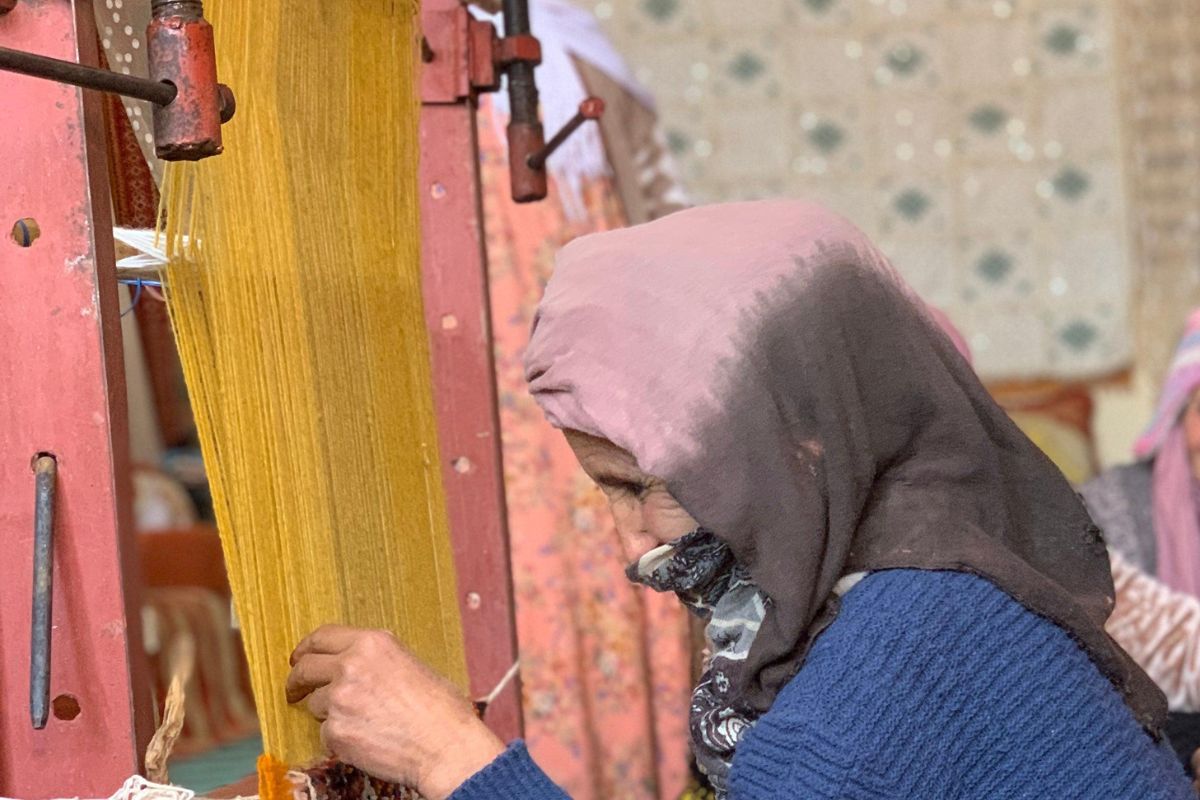
Moroccan rugs are woven overwhelmingly by women, most of them from Amazigh communities in the Atlas and Anti-Atlas regions, working either at home or through registered cooperatives. This is not folklore, it is documented in named reporting and in academic fieldwork. AFP in December 2024 named Ijja Benchri, a 60-year-old weaver in Taznakht, and Safia Imnoutres, who leads a local women's weaving cooperative there. Africanews in July 2025 named Naima Akhraze, a weaver at the Aguiness cooperative in the same town. The craft has names attached to it, and a rug described as the work of anonymous tribal artisans is being described lazily.
Women, specifically, and why that is well established
The gendered division here is one of the better-evidenced facts in the whole subject. Museum and academic sources agree with the journalism. The exhibition catalogue material for The Fabric of Moroccan Life, shown at the Indianapolis Museum of Art in 2002 and at the Smithsonian's National Museum of African Art in 2003, states that Berber women learned to weave out of tradition and necessity, producing garments and furnishing textiles for everyday use. The National Museum of African Art published Berber Textiles of Morocco: Technique and Tradition in 2009 off the back of that work.
Academic fieldwork says the same from closer range. Cynthia Becker's Amazigh Arts in Morocco: Women Shaping Berber Identity, published by the University of Texas Press in 2006, is built on years living among the Ait Khabbash, a Tamazight-speaking community in the Tafilalet oasis of southern Morocco, and argues that women's textile and visual arts are the vehicle through which Amazigh identity is carried between generations.
Amazigh or Berber, and why this site uses both
"Berber" is the word the English-language rug trade uses, including in the phrase Berber rug, and you will meet it on every listing. It comes from an exonym, a name applied from outside, and many communities prefer Amazigh, plural Imazighen, which is what people call themselves.
This guide uses Amazigh when describing people and communities and keeps "Berber" where it is the trade term a reader is actually searching, because pretending the trade word does not exist helps nobody trying to decode a listing. The distinction matters more than it looks: a page that only ever says "Berber tribal weaver" is reproducing the framing of the market rather than of the people in it, and that framing is exactly what makes it easy to sell a rug without ever naming who made it.
Where they work: home, then cooperative
Two settings, and the shift between them is recent enough to be reported rather than assumed. AFP photographed Ijja Benchri weaving on a wooden loom outside her small home in the village of Taznakht. Africanews described the same region's work moving from home-based weaving into cooperative workshops, framed as a way to secure steadier income and keep the profession alive as rural life changes.
The cooperative is a legal form, not a metaphor. Moroccan cooperatives are governed by Law 112-12, published in the Bulletin Officiel of 18 December 2014, which replaced the earlier 1983 framework, defines what a cooperative may do and establishes a public register. Morocco World News reported on 1 May 2026 that the country counted 8,027 women's cooperatives at the end of 2025, with more than 73,700 members between them, around 12 percent of all cooperatives nationally. Those are national figures across every sector, not weaving alone, and should not be read as a count of weavers.
The named organizations behind a style
For one region the organizational picture is unusually clear, which is why this site keeps returning to it. Africanews reported on 2 July 2025 that the Women's Centre for the Promotion of the Taznakht Carpet, established in 2016, brings together 35 cooperatives and 3,500 women weavers and can produce up to 300 carpets a month, with Abderrahmane Janah named as its manager. That is a named institution, a named person and a dated report, and it is the level of specificity this subject can reach when someone bothers.
Most named Moroccan styles do not have that. For the Azilal tradition and most of the Middle Atlas names on the Moroccan rug styles guide, the English-language record is thinner and consists largely of seller descriptions. The honest position is that the weavers behind those styles are equally real and are simply less documented in English, not that they are unknowable.
Men are in this trade too, in different roles
Saying women weave is not the same as saying the industry is women. AFP's reporting describes weavers travelling to a weekly market to sell to middlemen who set the prices, and the manager named at the Taznakht centre is a man. Urban workshop production, dyeing operations in Fes and Marrakech, export and retail are all part of the same chain.
The point is not to score this, it is that the person who wove a rug and the person who prices it are usually not the same person and are frequently not the same gender. Where the money sits between them is covered in what happens to a rug's price between the loom and the showroom, and it is the single most useful thing a buyer can understand about this trade.
What this site will not tell you about them
Some things are being asserted about Moroccan weavers online that nobody publishing from a keyboard can actually verify, and this guide will not join in.
- Individual earnings. AFP reported an average of about 250 dirhams, roughly 24 dollars, for a large rug sold to middlemen at the weekly market near Taznakht in December 2024. That is one named figure, from one place, at one date. It is not a wage, it is not a national average, and it does not describe what any particular weaver earns.
- Working conditions. No page can tell you the conditions behind a specific rug. Certification schemes and cooperative membership are real signals, but they are not proof, and this site does not present them as such.
- A cooperative's finances. Membership figures are published. Margins, payouts and internal accounts generally are not.
- What a motif means to the woman who wove it. Symbol meanings are asserted with total confidence across the seller SERP and are frequently projections. What museum and academic sources do support is narrower: the Moroccan exhibition material states that certain designs are believed by weavers to ensure fertility or carry protective power, and Becker documents fertility symbolism as prevalent among the Ait Khabbash specifically. Bruno Barbatti's Berber Carpets of Morocco: The Symbols, Origin and Meaning pushes much further, reading the geometric vocabulary as a system of Neolithic fertility signs, and that reading is disputed. The criticism this guide could find is in reviews and commentary rather than in a published academic rebuttal we could read, so treat the whole area as contested rather than settled. What "vintage" means on a Moroccan rug applies the same caution to the other unregulated word in this trade.
FAQ
Are Moroccan rugs made by women?
Mostly, yes, and it is well documented. Museum exhibition material, academic fieldwork and news reporting from Taznakht all describe weaving as women's work in Amazigh communities. Men are more commonly found in the selling, dyeing and export parts of the chain.
Should I say Amazigh or Berber?
Amazigh, plural Imazighen, is what many communities call themselves. Berber comes from an exonym and is the term the rug trade uses. This guide uses Amazigh for people and keeps Berber where it is the trade word a reader is searching.
Do weavers work alone?
Both. AFP photographed a weaver working at her own home loom, while Africanews described cooperative workshops in the same town. Larger looms can take more than one weaver at a time.
Can I find out who wove a specific rug?
Sometimes, and it is worth asking. Cooperative-direct sellers can often name the cooperative. A dealer who bought at a weekly market usually cannot, and a listing that says only "handmade by Berber artisans" is telling you nothing checkable.
How many women weave in Morocco?
There is no reliable national figure this guide can stand behind. Africanews reported 3,500 women weavers within one organization in Taznakht in July 2025. National cooperative counts cover every sector, not weaving, and many weavers work outside cooperatives entirely.
Leave a Reply