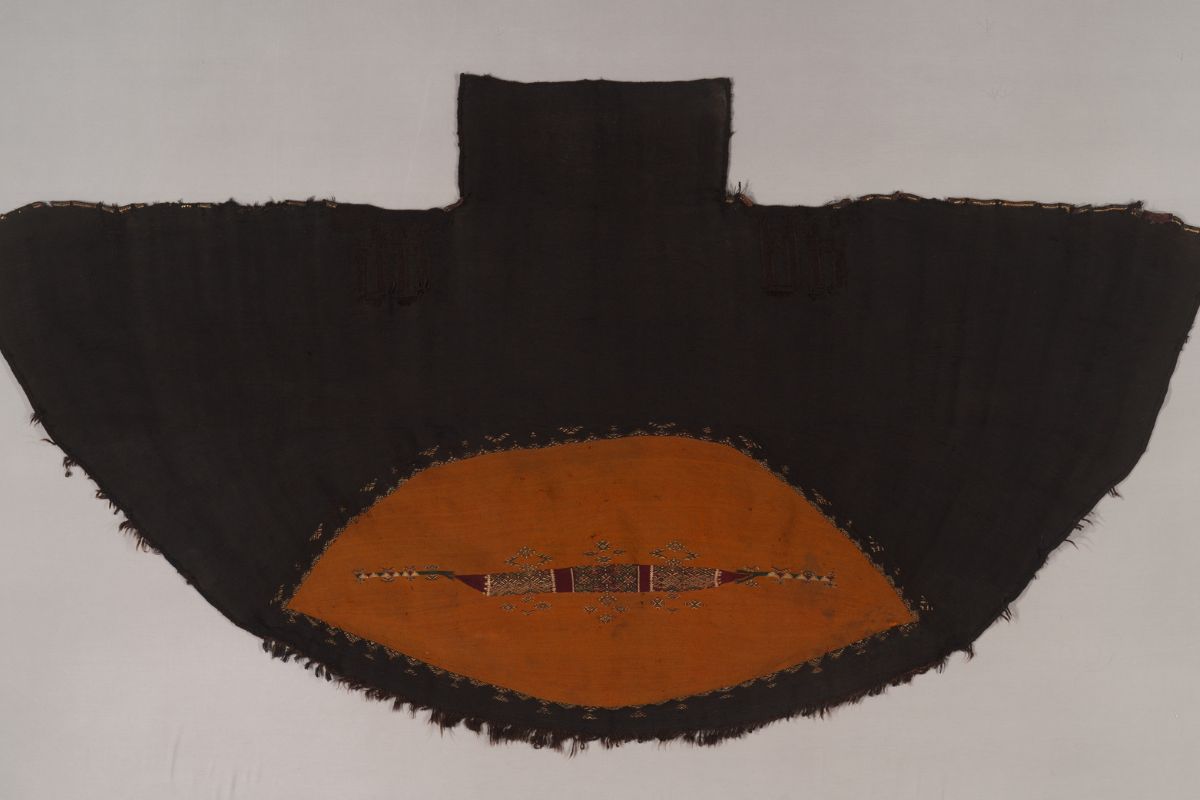
An akhnif is a handwoven hooded cape, not a rug. It was made by Aït Ouaouzguite Amazigh women in southern Morocco on a wide vertical loom, woven entirely to shape starting upside-down from the hood, in wool mixed with goat hair that gives the finished cloak its dark, near-black ground. If you've seen "akhnif" attached to a textile listing or a museum object and assumed it was some kind of floor covering, it isn't. It's clothing, and understanding that distinction matters for reading Amazigh-textile listings generally, not just this one item.
Not every Amazigh textile is a rug
Every other style page on this site covers a floor rug: something knotted or woven flat, meant to be walked on. The akhnif breaks that pattern on purpose, because it's a useful reminder that Amazigh weaving traditions produced far more than rugs: clothing, blankets, and ceremonial textiles all came out of the same regional weaving knowledge, often made by the same communities. A seller or a collector database that files an akhnif alongside "Moroccan rugs" is filing it in the wrong category, even if the weaving technique and cultural context genuinely overlap.
Unusually for this niche, the strongest sources on the akhnif are not rug dealers. They're museums and academic textile scholarship: the Art Institute of Chicago's own collection records, Smarthistory's dedicated essay on the akhnif, and a Textile Museum Journal article from The George Washington University's museum specifically reconstructing the historical akhnif of southern Morocco. That is a meaningfully different evidence base than most of what this site can cite for individual rug styles, and it lets this page state some facts with more confidence than usual.
How it's woven
The akhnif is woven entirely to shape on a wide vertical loom, starting upside-down from what becomes the hood. That is a genuinely demanding technical feat: the weaver has to control vertical warp tension and manage complex horizontal weft turns to build a curved shape into a flat weaving process, a skill Smarthistory's essay describes as reserved for the most experienced weavers. Once the main cloak was off the loom, male artisans, not the women who wove it, added the leather binding and other finishing details, a division of labor worth noting on its own, since it means the akhnif's production involved both women's and men's specialized work at different stages.
The body of the cape is wool blended with goat hair, which is what produces its distinctive dark, near-black color, rather than the undyed ivory associated with a style like Beni Ourain or the bright plant-dyed range seen in a piece like a Taznakht rug.
The motif on the back, and what it's said to mean
Every akhnif carries a prominent motif on its back, usually a circular or diamond-centered design that dominates the garment visually. Smarthistory's essay names this motif irghis n-ukhnif, translating it as roughly "the eye" or "the red of the akhnif," and describes it as serving two roles at once: it was the garment's visual focal point, and it functioned as a protective sign centered over the wearer's back.
That is a genuinely sourced symbolic reading, attributed to a specific academic essay, not a claim manufactured by a seller with a piece to move. This site is generally cautious about symbol-meaning claims for exactly that reason. Most "this pattern means X" statements found elsewhere in this niche trace to nobody in particular. Here, the source is named, which is why this page states the reading directly instead of hedging it into vagueness.
Who wore it, and why it largely disappeared
Akhnif capes were worn by men, and museum sourcing notes they were worn by both Muslim and Jewish men in the regions where the tradition was practiced, typically layered over a haik (a large wrapped cloth) or a jellaba (a hooded gown with sleeves). The akhnif functioned as an outer layer against cold, and its visual weight made it a garment of real social presence, not simply a practical wrap.
Production of new akhnifs largely stopped by the early 20th century. Museum sourcing attributes this to straightforward economics: the amount of skilled labor the weave demanded, combined with the cost of the wool involved, made the garment increasingly impractical to keep producing as available time, materials, and demand shifted. What survives today is largely older stock in collections and the antiques market, rather than an ongoing living production the way some rug traditions on this site still are.
Where to see real, documented examples
Because the akhnif is one of the most widely collected Amazigh textiles, documented examples sit in major public collections rather than only in private dealer inventories: the Art Institute of Chicago, the Peabody Museum of Archaeology and Ethnology at Harvard, the Metropolitan Museum, the Musée du Quai Branly in Paris, the Newark Museum, and the National Museum of World Cultures in the Netherlands all hold pieces. For a reader who wants to see a documented, provenanced example rather than a dealer photo, a museum collection record is the more reliable starting point.
Why this matters for reading other listings
If you encounter a Moroccan or Amazigh textile that clearly isn't a floor rug (a heavy woven cape, a ceremonial cloth, a blanket with a similar weaving character), it may well belong to this same broader craft tradition without being a rug at all. The weaving skill, the wool sourcing, and often the same regional or family lineages produced multiple kinds of textiles, not just carpets. A seller who describes every Amazigh textile they carry as a "rug" for search-engine convenience is flattening a genuinely wider craft into one product category, and a reader who only ever searches "Moroccan rug" may simply never encounter pieces like the akhnif at all. Treating "Moroccan rug" and "Moroccan weaving" as interchangeable terms, the way some general decor content does, misses real distinctions that matter both for accurate identification and for understanding the actual scope of Amazigh textile craft. See what "Berber rug" actually means for more on how loosely that broader terminology gets used in the trade.
FAQ
What is an akhnif?
A handwoven hooded cape made by Aït Ouaouzguite Amazigh women in southern Morocco, woven to shape on a vertical loom from wool mixed with goat hair. It is a garment, not a rug.
What does the motif on an akhnif mean?
Smarthistory's essay on the akhnif names the motif irghis n-ukhnif, translating it as "the eye" or "the red of the akhnif," and describes it as both the garment's visual focus and a protective sign. That attribution is to the essay specifically, not to unnamed tradition.
Who wore an akhnif?
Men, layered over a haik or jellaba. Museum sourcing notes it was worn by both Muslim and Jewish men in the regions where the weaving tradition was practiced.
Why did akhnif production largely stop?
Museum sourcing attributes the decline, by the early 20th century, to the heavy skilled labor the weave required combined with the cost of the wool, making it increasingly impractical to keep producing at scale.
Where can I see a real akhnif rather than a dealer photo?
Documented examples are held by the Art Institute of Chicago, the Peabody Museum at Harvard, the Metropolitan Museum, the Musée du Quai Branly, the Newark Museum, and the National Museum of World Cultures, among others.
Leave a Reply